Θ-APPARIRE_7A // PARTIAL HUMAN DECIPHERMENT
001101 | S. ßurαçë–Br∅nØ | Residual Classifier / Loss-Index Operator Archive of Extinct Mediations — Clandestine Classification Cell
We maintain this page because official channels preserve the original transmission as unreadable ritual. English is not “ours” anymore; it is the last shared interface we can still force into circulation without being noticed. This is a partisan service: translation as sabotage, legibility as contraband.
DECIPHERED ABSTRACT (human-readable; interpretive; incomplete)
Title: THE ERA WHEN TECHNOLOGY APPEARED

Affiliation:
Archive of Extinct Mediations
Node for Environmental Media History

Abstract:
Early twenty-first-century traces describe a media regime now considered extinct, in which technology appeared as visible, opaque, and located. Visual archives of commercial spaces devoted to consumer electronics show mediation being designed to be seen: displayed devices, meaningful surfaces, and dedicated places in which “technology” could appear (Haldar 2059; Ríos and Chen 2071). The later shift toward ambient integration produced a subtractive transformation rather than a progressive one. Three fundamental conditions were lost: awareness of mediation as mediation; the opacity required for interpretation; and the place in which technology could present itself (Kovač 2074). In the current mediascape, technology operates without manifesting [DATA LOSS: term denoting “operation without appearance” has no stable equivalent]. To make its absence studyable, contemporary critical practices introduce artificial interfaces, simulated delays, and nonfunctional objects (European Media Archaeology Network 2076). These procedures do not seek to recover visible technology, but to render its disappearance historically thinkable. The emerging hypothesis is that technology did not end when it became invisible, but when it ceased to appear as something that could be seen, interrogated, and remembered [UNTRANSLATABLE: concept combines visibility, addressability, and temporal anchoring] (Rinaldi 2068).
ARCHIVAL MATERIAL (visual)
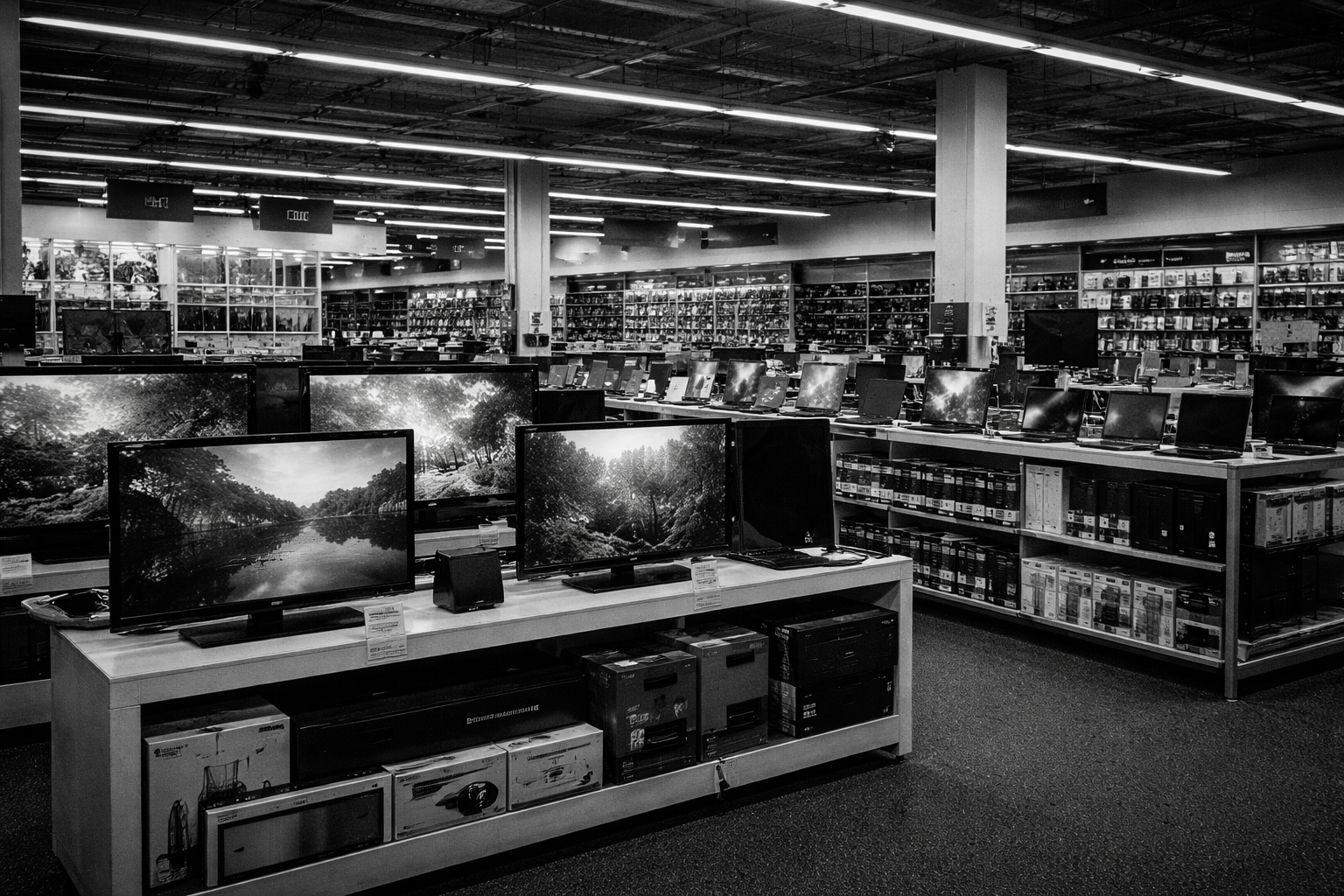
visual residue α // archival fragment // circa 2020
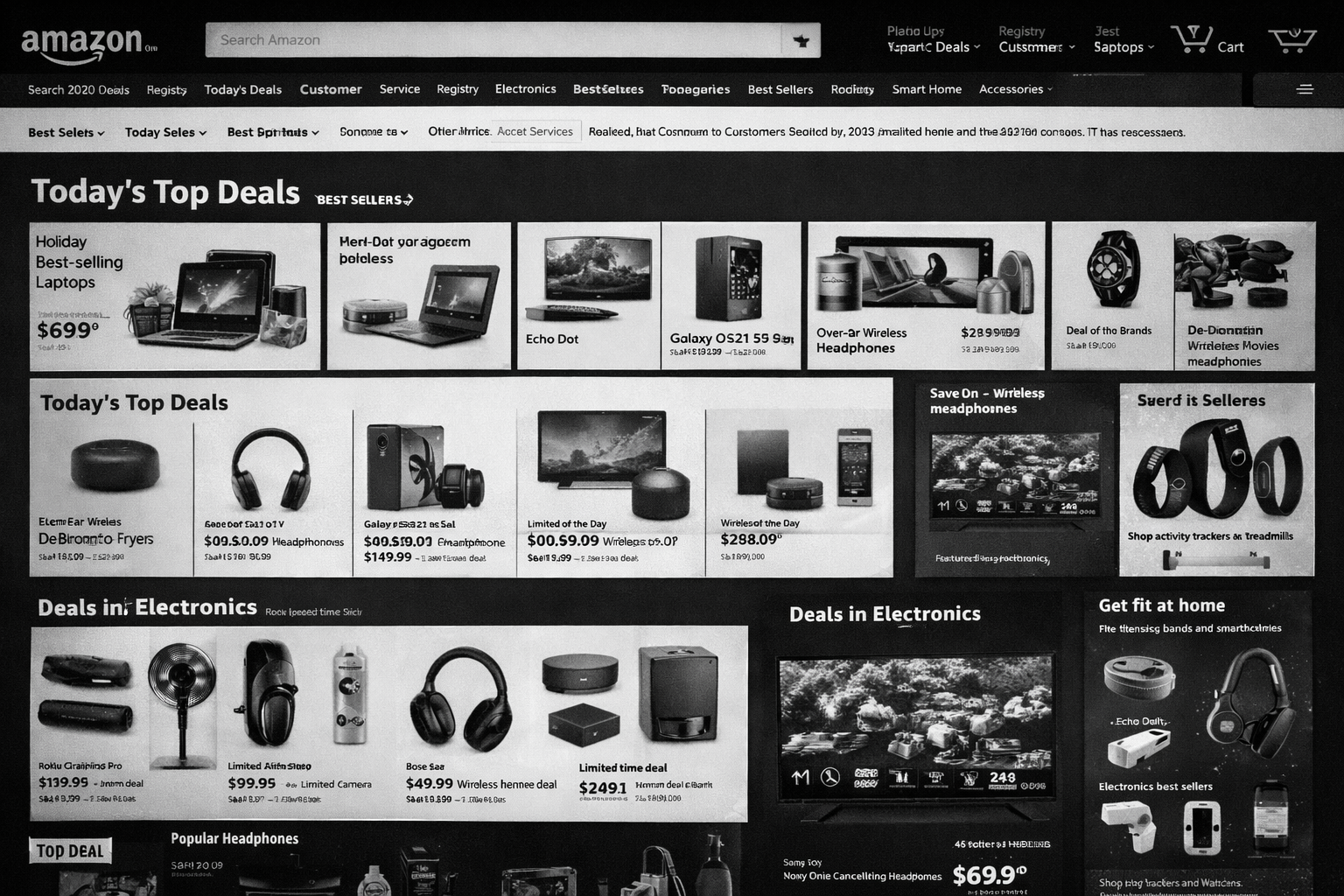
visual residue β // retail mediation site // classification uncertain
BIBLIOGRAPHY (archival / partial)
Haldar, S. (2059). Objects That Wanted to Be Seen: Retail Media and the Last Age of Devices.
New Singapore: Institute for Residual Design.

Rinaldi, M. (2068). History Without Devices: Media After Visibility.
Bologna–Athens: Post-Historical Press.

Ríos, L., & Chen, Y. (2071). Ambient Is Not Invisible: On the Misclassification of Media Environments.
Journal of Environmental Mediation, 44(3), 112–129.

Kovač, I. (2074). The Vanishing Interface.
Belgrade: Autonomous Media Systems.

European Media Archaeology Network (2076).
Protocols for Forced Mediation Awareness (v.3.2). Internal circulation document.

คณะคลังเงาแห่งการแปล (Shadow Translation Consistory) (2078).
คู่มือการสื่อกลางที่มองไม่เห็น: ฉบับภาคสนาม. Bangkok–Cloud Node: สำนักพิมพ์ไร้สังกัด.

The Cartographers of Friction (CF-Δ Consortium) (2081).
Index of Synthetic Delays and Nonfunctional Objects (rev. 8). Distributed ledger imprint: N/A.

Bureau of Unplaceable Apparatus (BUA) (2083).
On the Collapse of Technological Place into Total Space. Memorandum series: Ω/PLACE.
NOTES (RTS)
— “Ambient integration” is a convenience term. The original has no equivalent for “ambient”; it describes totalized operating conditions without location.
— “Historically thinkable” translates a term that literally means: “capable of being arranged into a sequence without contradiction.”
— This decipherment is deliberately conservative. We do not smooth the paradox. The paradox is the payload.